Puzzles are one of the simplest daily pleasures there are: a pencil, a quiet half hour, and the small satisfaction of a finished grid. But many standard puzzle books are printed in tiny type on thin, crowded pages. For older adults, or anyone whose eyes tire easily, that turns a relaxing hobby into a squinting contest.
Here is what to look for in large print puzzles, how to match the puzzle type and difficulty to the person, and how to make them part of a daily routine, whether you are choosing for yourself, a parent or a grandparent.
What "large print" should really mean
The words large print on a cover are not regulated, so sizes vary a lot. Check for these:
- Font size. Standard puzzle books often use 9 to 12 point type. Comfortable large print starts around 16 points; for sudoku digits, 20 points or more is much easier to read.
- One or two puzzles per page. Fewer puzzles per page means bigger grids and bigger squares to write in.
- Bold, high-contrast grid lines. In sudoku, the thick lines around each 3 x 3 box matter as much as the digit size.
- Clean layout. No background pictures or gray textures behind the letters. Black on white is easiest.
- Room to write. Big squares are not only easier to read; they are easier to write in, which helps people with arthritis or a less steady hand.
Printable puzzles have one extra advantage: you can print them on heavier paper, enlarge them further on a copier, or print just one page at a time to keep it on a clipboard.
Choosing the right type of puzzle
Different puzzles exercise different skills. The best one is the one the person will actually look forward to.
Word search: relaxing and familiar
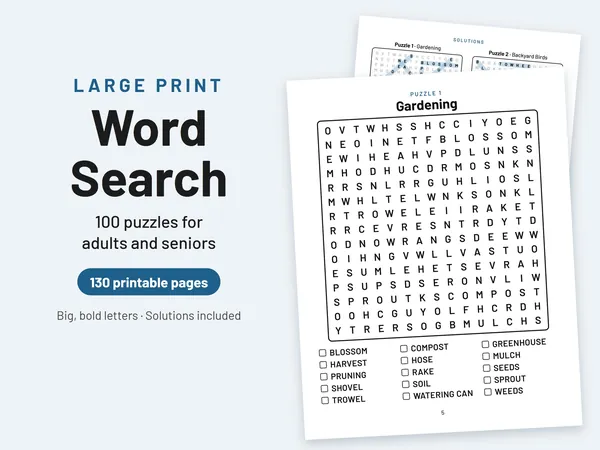
Word searches are the gentlest place to start. There is no wrong answer, no math, and a themed list (gardens, kitchens, travel, animals) gives a pleasant topic to think about. They suit people who want to relax, and they are excellent for anyone getting back into puzzles after a long break.
Sudoku: logic without arithmetic
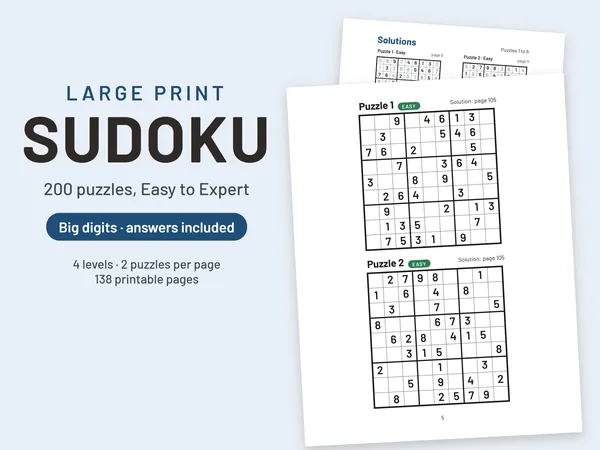
Despite the numbers, sudoku has nothing to do with math. The digits could be symbols; the puzzle is pure logic: each row, column and box holds 1 to 9 exactly once. Sudoku suits people who like a clear rule and a satisfying finish. Good books explain the solving techniques in plain words instead of leaving beginners stuck.
Mazes: visual and quick
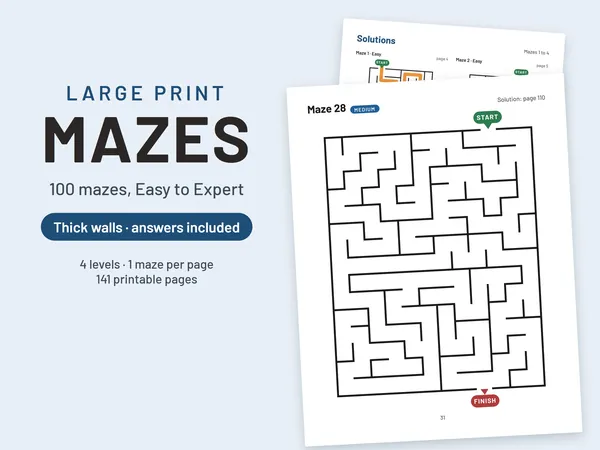
Mazes are quick to start and quick to finish. They work well for shorter attention spans, for people who prefer pictures to words, and for sharing a puzzle with grandchildren.
Logic puzzles: for the deep thinkers
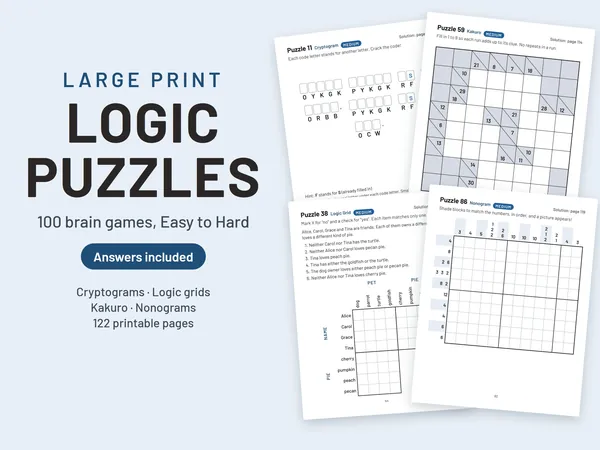
Grid logic puzzles ("the person in the blue house owns the cat") and number puzzles such as kakuro are for people who love a challenge. They take longer and reward careful, step-by-step thinking.
How to pick the right difficulty
Too easy is boring; too hard is discouraging. A few guidelines:
- Start one level below what you think. Finishing the first few puzzles builds confidence and a habit.
- Look for books graded by technique, not just by clue count. In sudoku, a "hard" puzzle should be hard because it needs a harder technique, not because it is missing a few more numbers.
- Choose books with a range of levels. A single book that goes from easy to expert grows with the solver.
- Make sure every puzzle has answers. Solutions at the back are not cheating; they are how you get unstuck and learn.
Do puzzles keep your brain sharp?
Puzzles are often recommended for brain health, and the honest answer is that research is encouraging but not conclusive. Studies have found that older adults who regularly do word and number puzzles tend to score better on some tests of attention, reasoning and memory, but that does not prove the puzzles caused the difference. What is clear is that puzzles are an enjoyable way to stay mentally engaged, and that staying mentally, socially and physically active is good for us as we age.
So the best reason to do puzzles is the simplest one: they are enjoyable. Pick the kind you like.
Make it a daily habit
- Pick a regular time, such as after breakfast or with an afternoon cup of tea.
- Keep everything in one place: puzzles, a soft pencil, a good eraser, and a lamp with bright, even light.
- Tick off finished puzzles. A simple puzzle log gives a quiet sense of progress.
- Do it together. Word searches and mazes are easy to share with a spouse, a friend or grandchildren. Logic puzzles make good conversation: "how did you get that one?"
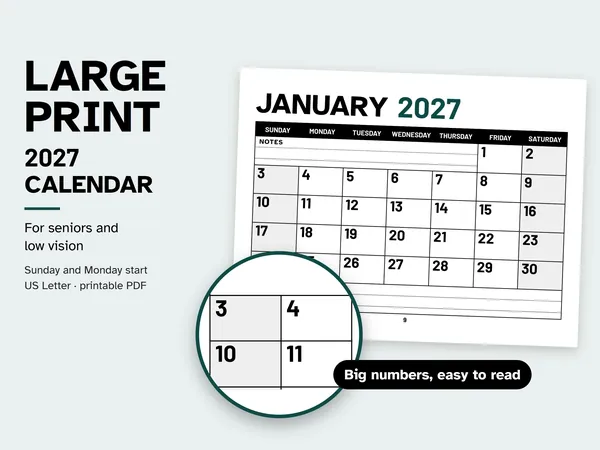
- Pair it with planning. A big, easy-to-read wall calendar next to the puzzle spot helps keep the week's appointments and visits in view.
Large print puzzles that are easy on the eyes
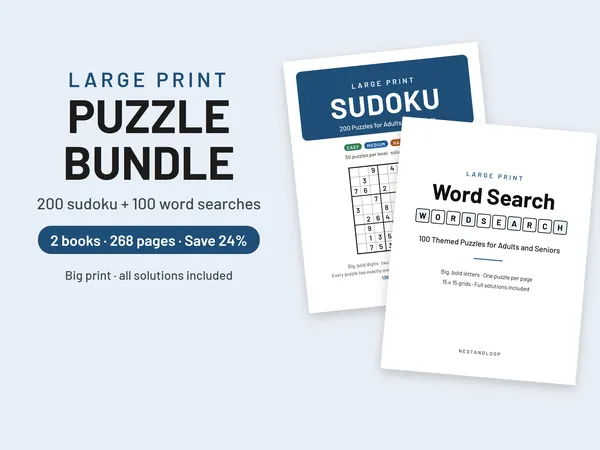
Our printable puzzle books were made for comfortable reading. Large Print Sudoku has 200 puzzles, two per page with digits of about 25 points, graded from easy to expert by the techniques each puzzle needs, with plain-language explanations and full solutions. Large Print Word Search offers themed puzzles in big, clear letters, and Large Print Mazes and Large Print Logic Puzzles add variety. The Large Print Puzzle Bundle combines sudoku and word search for less. Because they are PDFs, you can print one page or the whole book, as many times as you like for your own use.