A 12 x 12 multiplication chart has 144 facts, and to a third grader that can look like a mountain. The good news: once you know a few patterns, there are far fewer facts to memorize than it seems. Here is how to make times tables manageable, with a short daily plan.
Fewer facts than you think
- Turnarounds count once. 3 x 7 and 7 x 3 are the same fact. That alone cuts 144 facts to 78.
- The easy tables cover a lot. x0 (always 0), x1 (the same number), x2 (doubles), x5 (ends in 0 or 5) and x10 (add a zero) are quick to learn.
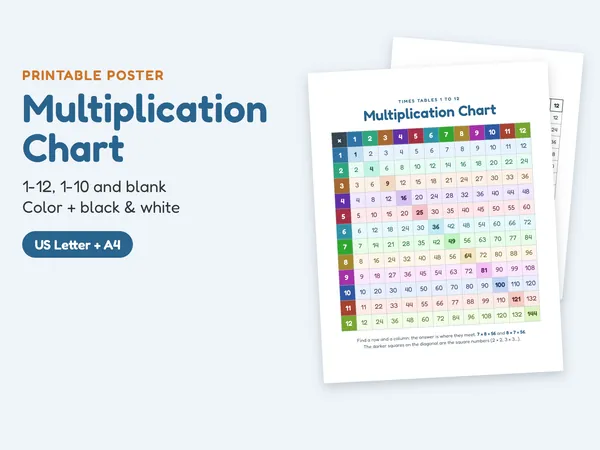
- Square facts (3 x 3, 4 x 4, up to 12 x 12) have their own pattern on the chart's diagonal and are easy to remember.
Once those are known, the truly hard facts inside the 1 to 10 tables come down to about 15: the pairs made from 3, 4, 6, 7, 8 and 9, such as 6 x 7, 7 x 8 and 8 x 9.
The best order to learn them
- x2, x10, x5: skip counting the child already knows.
- x1 and x0: rules rather than facts.
- x4: double the double (4 x 6: double 6 is 12, double 12 is 24).
- x3: a double plus one more group.
- x9: the finger trick and the digit pattern.
- Squares.
- x6, x7, x8: by then most of these facts are already known from other tables.
- x11 and x12 if your school uses them.
Tricks for the harder tables
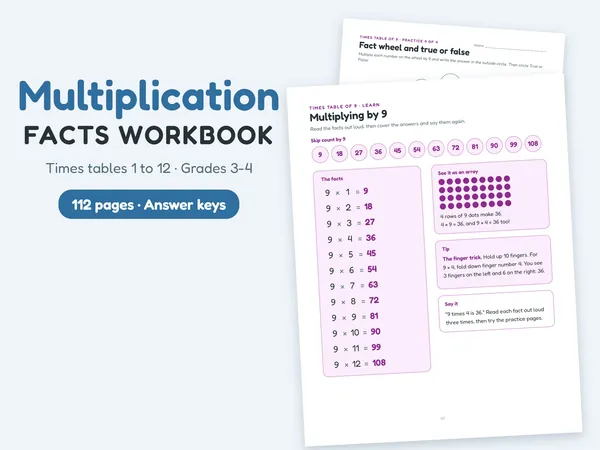
- 9s, finger trick: hold up ten fingers. For 9 x 4, fold down the fourth finger: 3 fingers to the left, 6 to the right: 36.
- 9s, pattern: the tens digit is one less than the number you multiply by, and the two digits add up to 9 (9 x 7 = 63, 6 + 3 = 9).
- 8s: double three times. 8 x 7: 14, 28, 56.
- 6s: five groups plus one more. 6 x 7 = 35 + 7 = 42.
- 11s up to 9: repeat the digit (11 x 4 = 44).
- 12s: ten groups plus two groups. 12 x 7 = 70 + 14 = 84.
- The 5-6-7-8 fact: 56 = 7 x 8.
Understand first, then memorize
Children learn facts faster when they know what multiplication means. Before drills, show 3 x 4 as 3 rows of 4 counters (an array), as 3 jumps of 4 on a number line, and as 3 bags with 4 apples each. When a fact is forgotten, the child can then rebuild it from a known fact instead of guessing: "I know 5 x 7 is 35, so 6 x 7 is 7 more."
Practice that works
- Little and often: 10 minutes a day beats an hour on Sunday.
- One table at a time, then mix it with the tables already known.
- Say it, write it, use it: read the facts aloud, fill in the missing factor (7 x ? = 56), solve word problems.
- Track progress on a chart: color each fact as it becomes instant.
- Timed practice, gently. Short timed sets help build speed for some children but cause stress for others. Compare a child only with their own last score, and drop the timer if it brings tears.
Games for times tables
- Multiplication war: each player flips two cards and multiplies; the bigger product wins the cards.
- Dice products: roll two dice and multiply; use 10- or 12-sided dice for higher tables.
- Chart cover-up: cover facts on a multiplication chart with coins and say each answer before lifting the coin.
- Fact of the day: stick one hard fact on the fridge and ask it at every meal.
A 4-week plan
- Week 1: x2, x5, x10, x1 and x0, with arrays and skip counting.
- Week 2: x4 and x3, plus the squares.
- Week 3: x9, then x6.
- Week 4: x7 and x8, then mixed review of everything.
Spend about 10 minutes a day. Children who need more time can spend two weeks per step; the order matters more than the speed.
Then move on to division
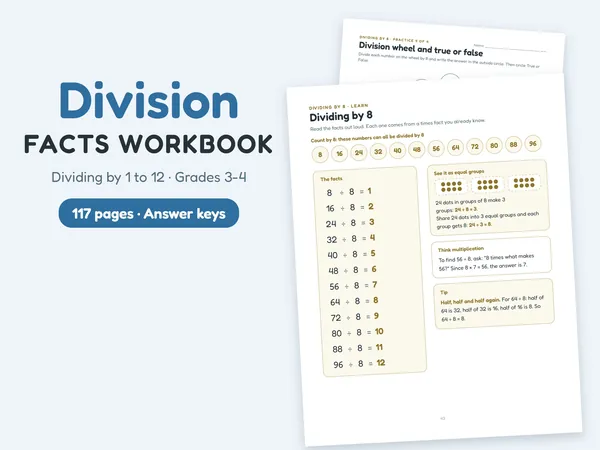
Every division fact is a multiplication fact backward: 56 ÷ 8 = 7 because 8 x 7 = 56. Children who know their tables well find division easy when it is taught as "fact families".
Printables for times tables
Our Multiplication Facts Workbook follows this approach: a Learn page for every table with skip counting, an array and a strategy tip, four practice pages per table, timed tests, word problems, a progress tracker and full answer keys. Pin up a Multiplication Chart Poster by the desk (there are blank charts to fill in, too), and continue with the Division Facts Workbook when the tables are solid.