Words like the, said, was and of show up on almost every page a young child reads. When a child recognizes them instantly, reading suddenly flows; when every one of them has to be puzzled out, a short story feels like hard work. Here is how to teach sight words in a way that actually sticks, in a few minutes a day.
What sight words are
"Sight words" usually means the most common words in children's books. A small group of them makes up a big share of everything a beginner reads, which is why they are worth learning early.
Two lists are used in most US schools:
- Dolch words: 220 "service words" (plus 95 common nouns) compiled by Edward Dolch from children's books, grouped into five levels: Pre-Primer, Primer, First, Second and Third Grade.
- Fry words: 1,000 words ranked by how often they appear in reading material, taught in groups of 100.
They overlap heavily. Dolch is a neat, finite set for Pre-K to 3rd grade; Fry goes further for older readers. Either one works. What matters most is how you teach them.
Sight words are not just memorized shapes
Children do not remember words as pictures. They remember them by linking sounds to letters. That is good news: most "sight words" are fully decodable (and, it, can, went), and the others have only one tricky part. In said, the s and d are regular; only the ai is unexpected.
Many teachers call that tricky part the heart part: the bit you have to "learn by heart". Show your child which letters sound the way they expect, and put a little heart over the part that does not. It turns a random word into a word with one surprise.
How many words at a time?
- Ages 4 to 5: two or three new words a week.
- Ages 6 to 7: three to five new words a week.
- Keep reviewing old words. A word is "known" when your child reads it instantly, in any book, several days in a row.
Starting with fewer words and mastering them beats racing through a list.
A 5-step routine for each new word
Spend about five minutes on it, once or twice a day.
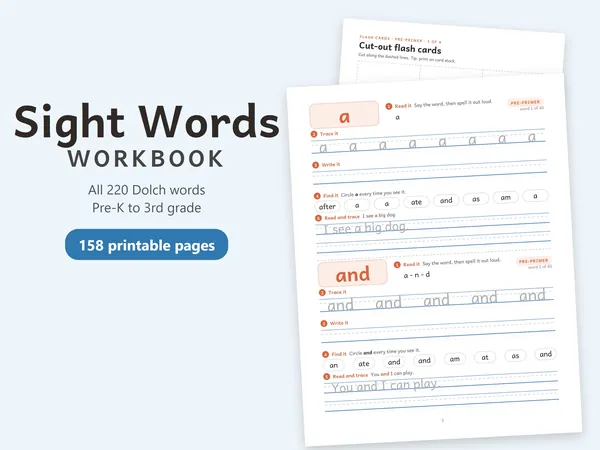
- Read and spell it aloud. "This word is was. W-A-S, was."
- Trace it while saying each letter.
- Write it from memory, then check.
- Find it in a row of look-alike words (was, saw, wax, was) or in a picture book.
- Read it in a sentence: "The cat was on the mat."
Saying, tracing, writing and finding the word links its sound, spelling and meaning, which is exactly what makes recall fast.
Games that make practice fun
- Flash card flip: read a stack of cards; the ones read instantly go in the "fast" pile, the others are practiced again.
- Word hunt: pick one word and count how many times it appears on a page of a favorite book.
- Swat it: spread cards on the table, call a word, and your child swats it with a fly swatter or a spoon.
- Go Fish with words: make two cards of each word and play the classic game.
- Hop and read: tape cards to the floor and hop from one to the next, reading each one.
- Sentence builder: mix sight word cards with picture cards to build silly sentences.
Keep games short and stop while your child still wants more.
Keep phonics going alongside
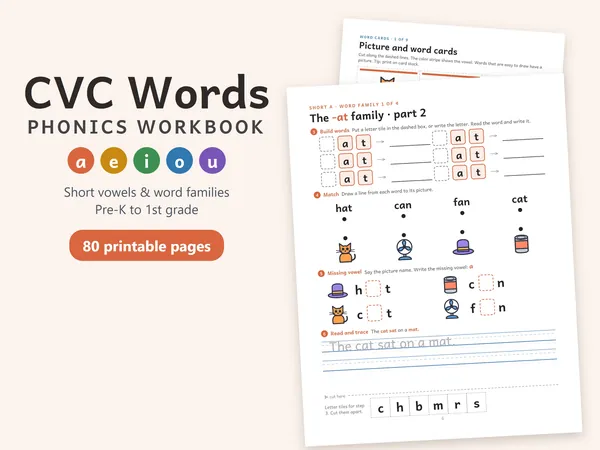
Sight words help children read sooner, but they are not a replacement for phonics. Short-vowel CVC words (cat, pig, sun) teach children how to sound out new words on their own. The best mix is a few sight words and a few phonics patterns each week, with lots of reading of easy books.
Signs a child needs a little more help
If a child still cannot remember words after many weeks of short daily practice, mixes up many letter sounds, or finds reading unusually tiring, talk to their teacher or pediatrician. Early support makes a big difference.
Printables for sight word practice
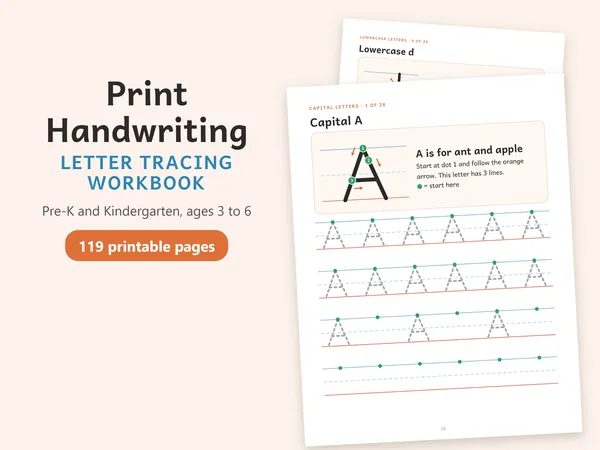
Our Sight Words Workbook covers all 220 Dolch words in five levels, with the five-step routine above on every word (read, trace, write, find, read in a sentence), review pages, word searches, checklists and printable flash cards. For decoding practice alongside, the CVC Words Phonics Workbook builds short-vowel reading, and the Print Handwriting Workbook helps with letter formation. Print a level, or one page, as many times as you need.