Parents and homeschoolers ask this question every year: should a child learn print or cursive first? And once they can print, is cursive still worth teaching? The short answer is that most American children learn print first, in preschool and kindergarten, and add cursive around second or third grade. But there are good reasons behind that order, and some families choose differently.
Here is what each style does, the typical timeline, and how to tell when your child is ready for the next step.
What is the difference between print and cursive?
Print (also called manuscript) uses separate letters built from straight lines and circles. Most US schools teach a simple "ball-and-stick" style: a capital B is a straight line with two bumps, a lowercase a is a circle with a line beside it.
Cursive joins the letters of a word in one continuous movement. Each letter starts with an upstroke and ends with a connecting stroke, so the pen rarely leaves the paper until the word is finished.
Both styles use the same alphabet and the same guidelines, but they train the hand differently.
The case for teaching print first
- It matches what children read. Books, signs and screens all use print. Writing the same shapes they see on the page helps children connect letters with sounds, which supports early reading.
- The shapes are simpler. Lines and circles are the first marks young children can draw. Most four- and five-year-olds can make a vertical line, a horizontal line, a circle and a cross before they can manage a smooth loop.
- It is what schools expect. Kindergarten and first grade worksheets, spelling tests and early writing assignments are almost always in print.
The case for cursive (and cursive first)
- Fewer pen lifts, fewer reversals. Because every cursive letter starts on the baseline with an upstroke, children who confuse b and d in print often stop reversing them in cursive.
- Words become units. Writing a word in one movement reinforces spelling as a whole shape.
- It is faster once learned. Older children who write a lot often find cursive, or a joined mix of print and cursive, faster and less tiring than separate letters.
- It is coming back. After years of being dropped from many curriculums, cursive is required again in a growing number of states, including California since 2023.
Some Montessori and classical programs teach cursive first for exactly these reasons. It works, especially with good guidelines and lots of tracing, but it is less common in the US.
When do kids usually learn each one?
A typical US timeline looks like this:
- Ages 3 to 4 (preschool): pre-writing strokes such as lines, zigzags, waves and circles; first capital letters, often the ones in the child's name.
- Ages 4 to 6 (Pre-K and kindergarten): all capital and lowercase print letters, numbers to 20, then short words like cat, sun and map.
- Ages 6 to 7 (first grade): neat print on smaller lines, full sentences, spacing between words.
- Ages 7 to 9 (second and third grade): cursive lowercase, then capitals, joins and sentences.
These are averages, not deadlines. Some children are ready for cursive at six; others are better off waiting until eight.
Signs your child is ready for cursive
Look for these before you start:
- Prints all letters from memory, without looking at a chart.
- Holds a pencil with a relaxed tripod grip (thumb, index and middle finger).
- Keeps letters mostly on the line and roughly the right height.
- Can copy a short sentence from the board or a book without losing their place.
- Shows interest: many children want to learn "grown-up writing" once they see a parent or older sibling use it.
If your child is still struggling to form print letters, give it a few more months. Cursive builds on the same control.
How to practice at home without tears
Short and regular is the rule for both styles.
- Keep sessions to 10 or 15 minutes. Stop before your child gets tired; handwriting with a tired hand only practices the wrong movements.
- Use three- or four-line guidelines. A dashed middle line tells a child exactly how tall small letters should be.
- Trace, then write. Tracing a gray model shows the movement; writing on their own builds memory. One row of each is plenty.
- Teach the starting point. For print, a dot and an arrow showing where each letter starts prevents most reversals. For cursive, every lowercase letter starts on the baseline.
- Move from letters to words quickly. Children enjoy writing real words (their name, animals, foods) far more than rows of the same letter.
- Celebrate progress. A progress chart or a certificate at the end of a workbook means a lot to a seven-year-old.
Tips for left-handed children
Tilt the paper to the right instead of the left, so the hand stays below the line and does not smudge the writing. Let the child hold the pencil a little higher up. Cursive is perfectly learnable for left-handers; the slant may simply be more upright, and that is fine.
So, which one first?
For most families: print first, then cursive around second or third grade, when print is automatic and the child is curious. If your child has trouble with letter reversals or finds lifting the pencil frustrating, starting cursive a little earlier is a reasonable choice.
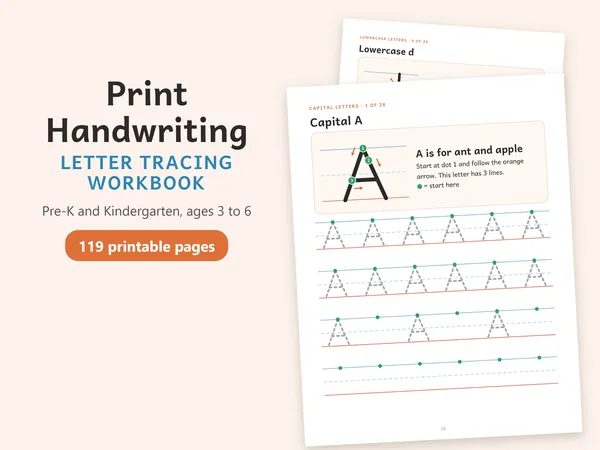
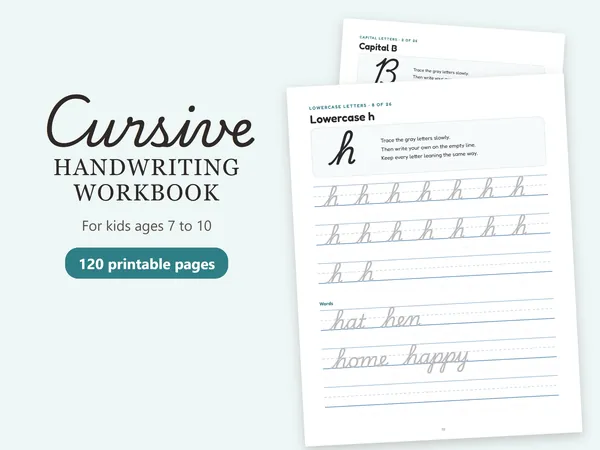
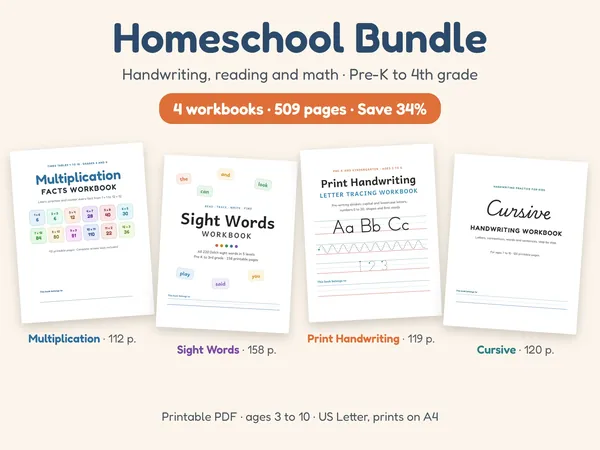
Whichever you choose, a clear model and good guidelines matter more than the order. Our Print Handwriting Workbook covers pre-writing strokes, capital and lowercase letters with numbered start dots and arrows, numbers and first words for Pre-K and kindergarten. The Cursive Handwriting Workbook for Kids picks up from there with warm-ups, one page per letter, tricky connections, words, sentences and a progress chart. Both are part of the Homeschool Workbook Bundle, alongside sight words and multiplication facts.