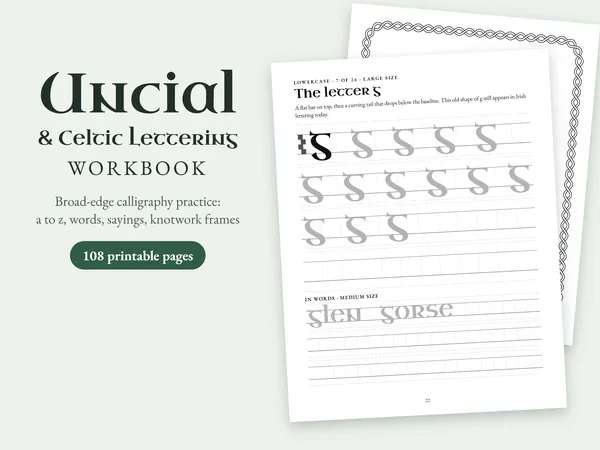
Uncial is the round, open lettering you see on Irish signs, pub boards, festival posters and anything with a Celtic feel. It was a book hand of late Roman and early medieval scribes, and Irish and Northumbrian scribes developed their own rounded versions of it. Today it is a favorite for beginners: few letters have tall ascenders, there is only one case, and the shapes are wide and friendly.
What makes uncial different
- One alphabet. Uncial has no separate lowercase and capitals. A letter can be written larger at the start of a word, but the shapes are the same.
- Round shapes. The o is almost a full circle, and a, d, e, m and others are built around it.
- Short ascenders and descenders. Letters such as d, h and l rise only a little above the body, which keeps lines compact and easy to read.
- A flat pen angle. Uncial uses a lower pen angle than most scripts, which gives thick verticals and fairly thin horizontals.
Tools
- A chisel-tip calligraphy marker of about 3 to 4 mm for your first pages.
- A broad-edge dip pen or calligraphy fountain pen (3.8 mm or 2.4 mm) once you want sharper edges.
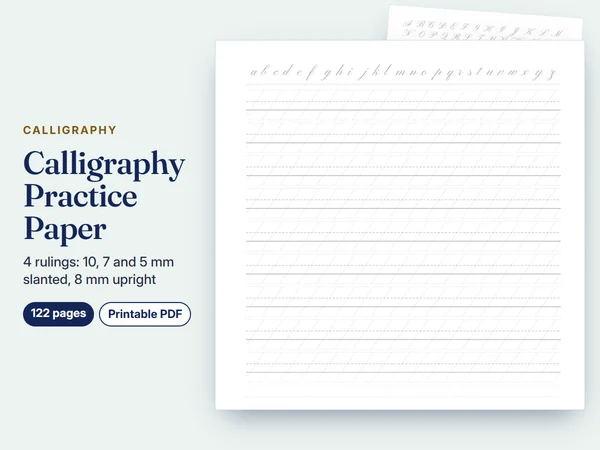
- Guidelines sized in nib widths for your pen.
- Smooth printer paper is fine. Use a sheet of scrap paper under your hand to keep the page clean.
Pen angle and nib widths
Hold the flat edge of the pen at about 20 to 25 degrees to the baseline. Keep it there through every stroke: do not let it turn as you make the curves.
Uncial is measured in nib widths. A common proportion is an x-height of 4 nib widths, with ascenders and descenders of about 1 to 2 more. Turn the pen sideways and stack small squares to make a ladder, then draw your guidelines from it. A bigger pen means bigger letters, with the same proportions.
The basic strokes
- Stem: a thick vertical, short and steady.
- Flat stroke: a short horizontal with a thin line, for tops of t and e.
- Left curve: the left side of o, c, d and e.
- Right curve: the right side of o and the bowls of b and p.
- Round o: two curves that meet to form a wide circle.
- Arch: the curved top of h, m and n.
- Bowl: a curve attached to a stem.
- Diagonals: thick and thin strokes for v, w, x, y.
Practice each one in a row before moving to letters. The circle is the most important: when your o is round and even, the rest of the alphabet follows.
Writing the alphabet
Learn the letters in groups that share a stroke:
- Round letters: o, c, e, d, q.
- Stem and arch: h, m, n.
- Stem and bowl: b, p, r.
- Diagonals: v, w, x, y, k.
- The distinctive uncial letters: a, g, s and t, which look the least like modern letters. Give them extra time.
Keep the spaces inside and between letters similar, so a word looks like an even row of round shapes.
Celtic knotwork
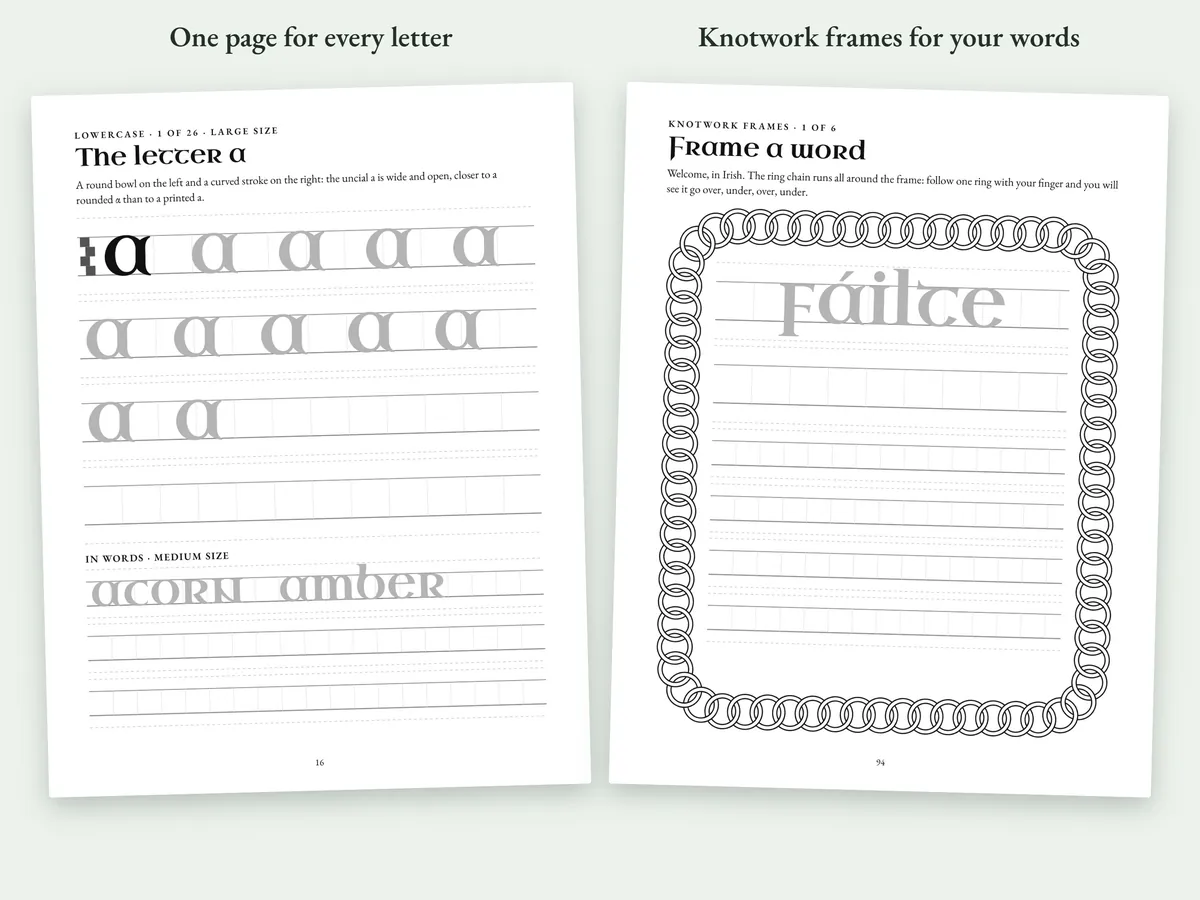
Uncial pairs naturally with knotwork: interlaced lines that wrap around a word, a name or a short saying. Simple borders made of linked rings or a two-strand twist are a good way to start, and they turn a practice word into a small framed piece.
Practice ideas
- Your name in uncial, inside a knotwork frame.
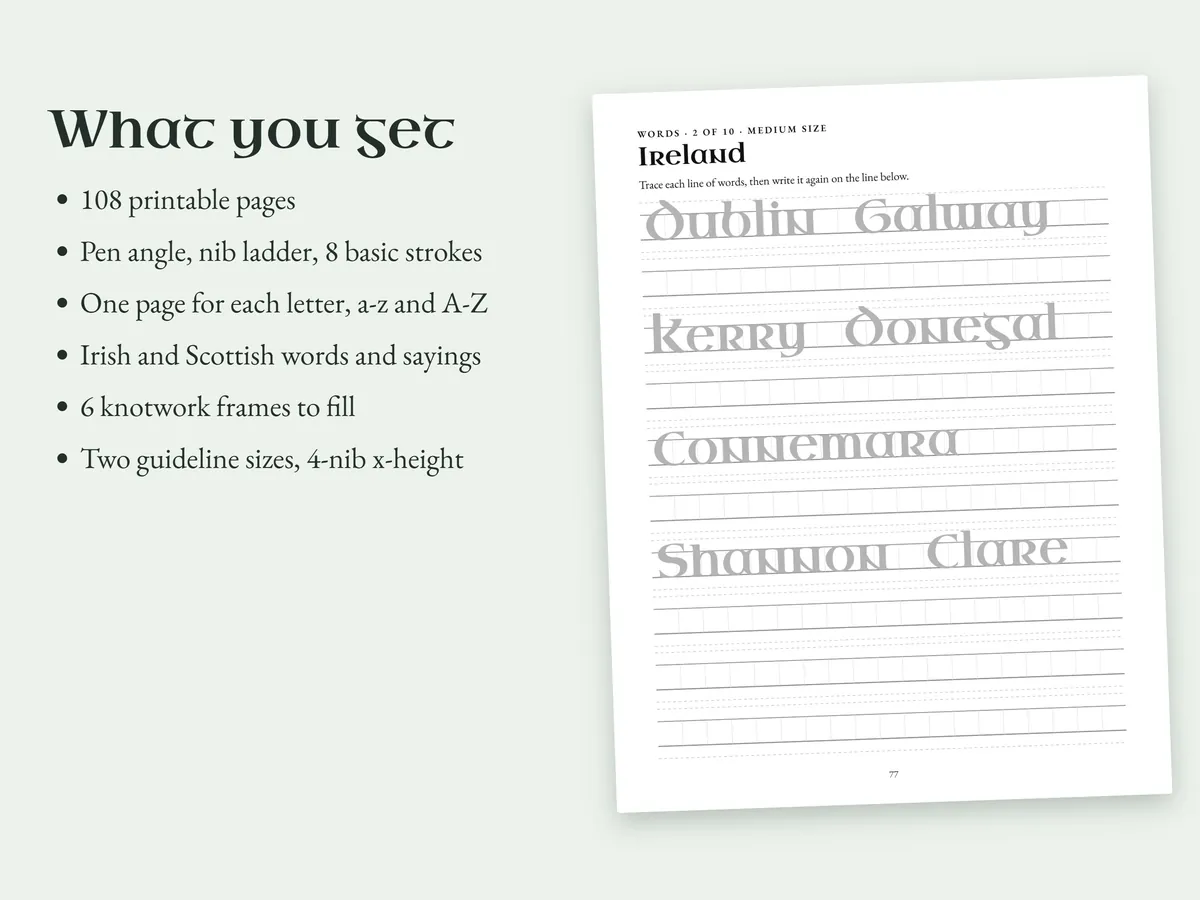
- Irish and Scottish place names: Dublin, Galway, Kerry, Skye.
- Short words such as fáilte (welcome) or sláinte (good health).
- Labels for a herb garden or a recipe binder.
An uncial workbook to follow
Our Uncial & Celtic Lettering Workbook explains the pen angle, nib ladder and guidelines, then gives you 8 basic strokes, one page for every letter with words, capitals with Irish and Scottish place names, numerals, traditional sayings and 6 knotwork frames to trace, in two guideline sizes. You will find our other scripts, including blackletter, in the calligraphy and lettering collection.