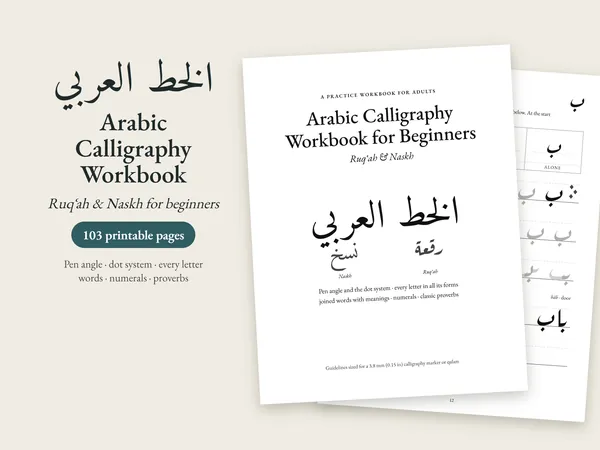
Arabic calligraphy is one of the richest lettering traditions in the world, and you do not need to speak Arabic to start. The alphabet has 28 letters, it is written from right to left, and most letters join to their neighbors. With the right pen and a clear method, a beginner can write readable, good-looking words within a few weeks.
The main Arabic calligraphy styles
- Naskh: clear, balanced and the base of most printed Arabic. The best script for learning proportions.
- Ruqah (Riq'a): the everyday handwriting of much of the Arab world. Compact, quick and sitting low on the line, with few flourishes.
- Thuluth: large, sweeping and ornamental, used for titles and architecture. Beautiful, but not a beginner script.
- Diwani: flowing and tightly packed, once used for official documents.
- Kufic: angular and geometric, the oldest of the classic styles.
Ruqah or Naskh first?
Ruqah is the fastest way to write Arabic by hand with style. Its letters are simple and short, and it is what people actually use for notes and signs.
Naskh teaches you the classic proportions of each letter. It takes a little longer, but everything you learn transfers to the more decorative scripts later.
Many teachers suggest learning both: Ruqah for confidence, Naskh for precision. If you only choose one, choose Naskh if you want to move on to other styles, Ruqah if you want handsome handwriting quickly.
Tools
- The qalam: the traditional pen, a reed or bamboo cut with a slanted, broad tip. It needs to be cut and trimmed, so it takes some practice to prepare.
- A 3.8 mm calligraphy marker with a chisel tip: the easiest start. No cutting, no ink spills.
- Ink and smooth paper: any black calligraphy ink. Traditional calligraphers use specially polished paper, but smooth printer paper is fine for practice.
Left-handers are welcome: Arabic runs right to left, so the hand moves away from the fresh ink.
The dot system (nuqta)
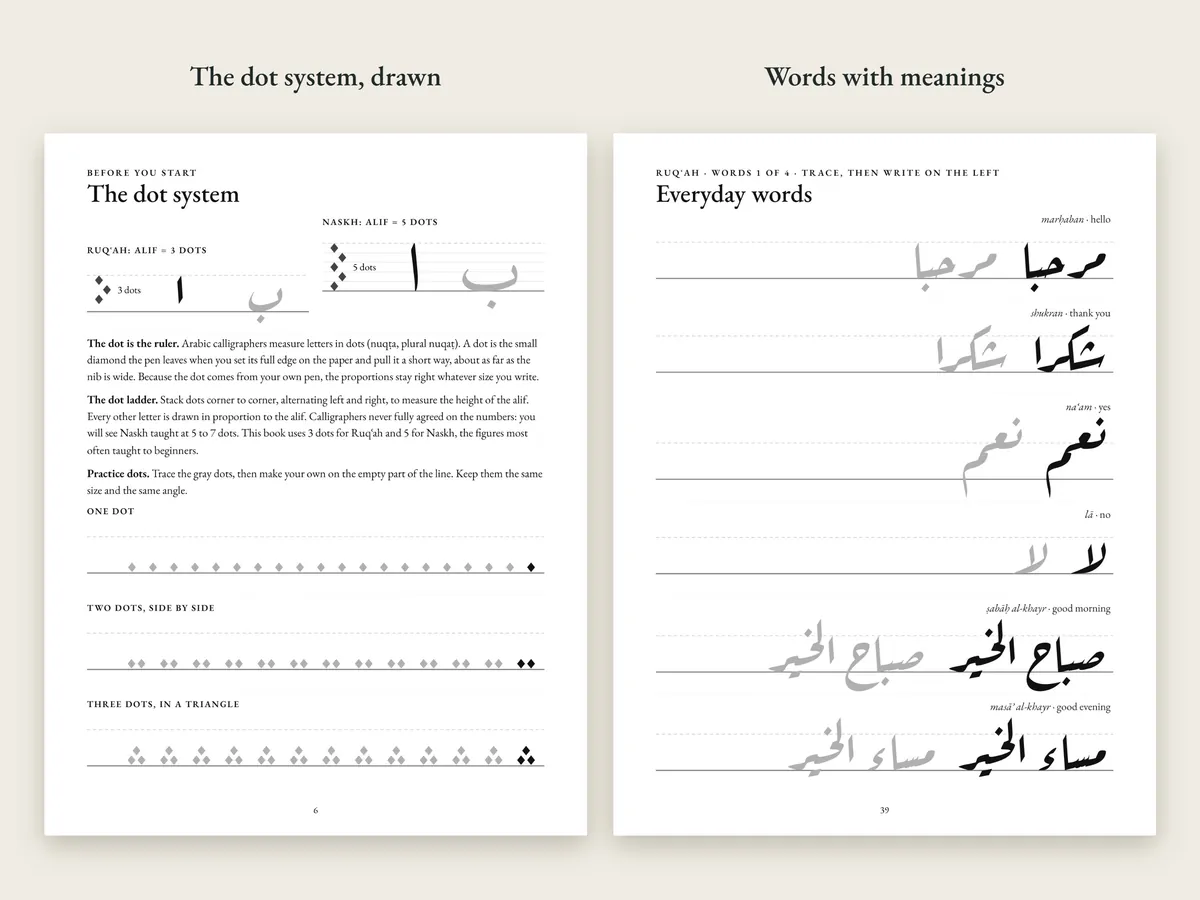
Arabic calligraphy measures letters with dots: small rhombus shapes made with the pen itself, pressed at its usual angle. Stack the dots and you get a ladder for that pen, just like nib widths in Western calligraphy.
The alif, the vertical first letter, sets the scale. In Ruqah it is usually about 3 dots tall; in Naskh about 5 dots. Every other letter is sized from it. Change the pen and the letters grow or shrink, but the proportions stay.
Letter forms and joining
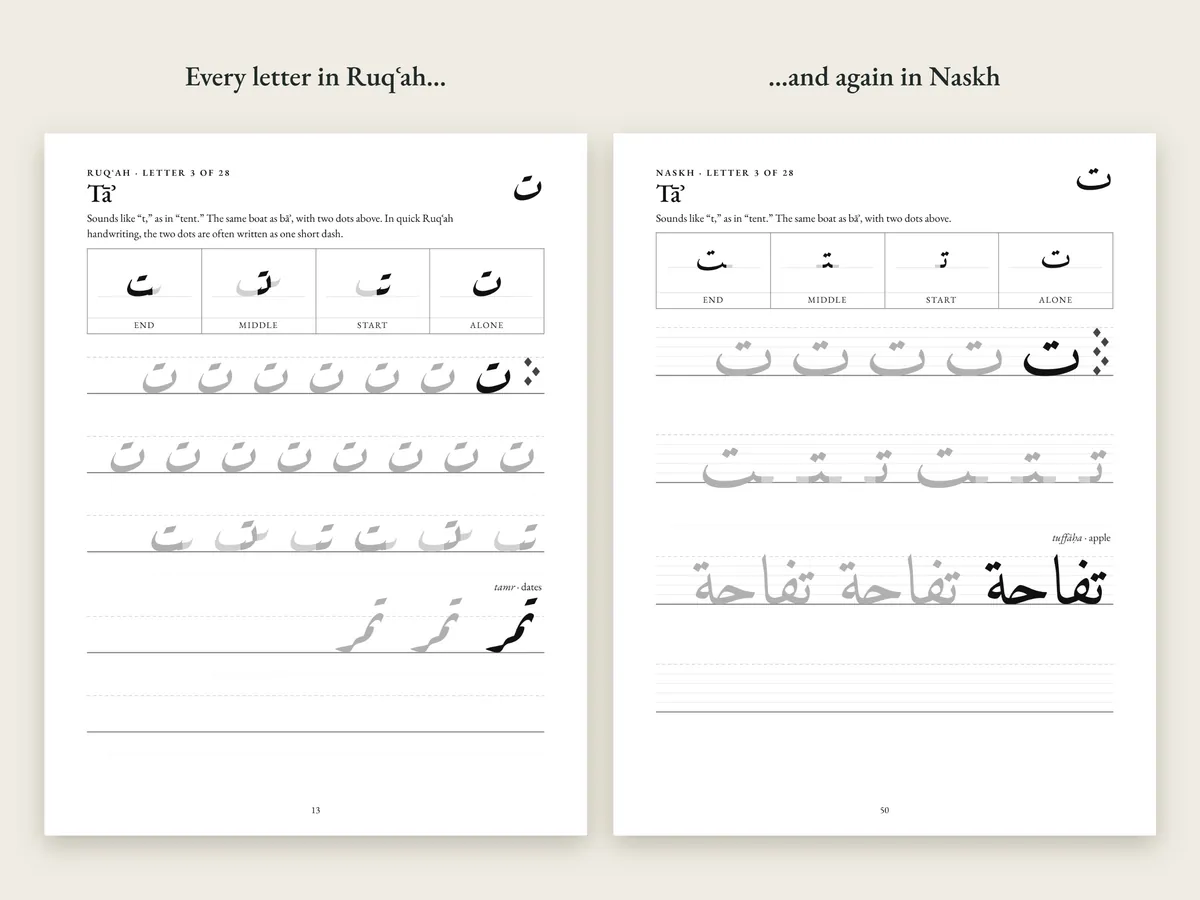
Most Arabic letters have up to four forms: alone, at the start of a word, in the middle and at the end. The basic shape stays recognizable, but the tail or the connection changes. Six letters (ا د ذ ر ز و) never join to the letter after them, so a word can have small breaks inside it.
Learn each letter in all its forms, then write it inside short words. Words teach joining better than isolated letters.
Tips for beginners
- Keep the pen angle steady for each script, as shown in your models.
- Start each line at the right edge and leave the left side free.
- Dots matter: letters such as ب ت ث differ only by their dots. Place them carefully, centered on the shape.
- Go slowly on curves such as the tail of ن and ي.
- Trace, then copy: trace a model a few times, then write it freehand next to it.
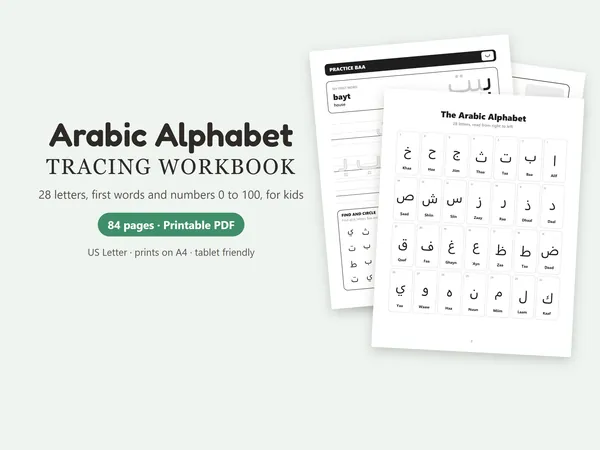
A two-script Arabic workbook
Our Arabic Calligraphy Workbook: Ruqah & Naskh is made for adult beginners: tools, pen angle, the dot system with drawn ladders, then all 28 letters in both scripts with their four forms, joined words with transliteration and meaning, numerals, classic proverbs and lines of poetry to trace, and free practice pages. If you are still learning the letters themselves, start with the Arabic Alphabet Tracing Workbook, and see why Arabic is easier than it looks in the easiest foreign alphabet to learn.