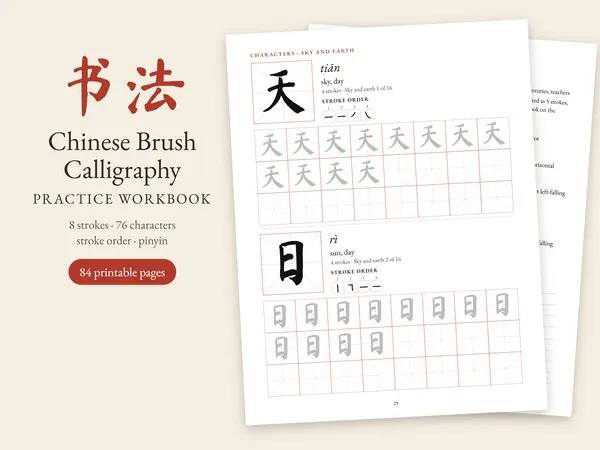
Chinese calligraphy (书法, shūfǎ) is the art of writing characters with a brush. It looks like an art for experts, but every character is built from a small set of strokes written in a fixed order. Learn those strokes and the rules, and you can write your first characters well within a few days of practice.
The five main scripts
- Seal script (篆书): the oldest style still written, rounded and even.
- Clerical script (隶书): wide and flat, with flared horizontal strokes.
- Regular script (楷书, kǎishū): clear and upright, each stroke separate. This is where beginners start.
- Running script (行书): a faster, joined version of regular script.
- Cursive script (草书): very fast and abbreviated, for advanced writers.
What you need
The traditional set is called the Four Treasures of the Study: brush, ink, paper and inkstone. To begin, you can simplify:
- A brush pen is the easiest start: no ink to grind, and it works on printer paper.
- A medium Chinese brush (a mix of goat and weasel hair is forgiving) when you want real brushwork.
- Bottled ink instead of an ink stick and inkstone.
- Practice paper with grids, or rice paper for brush and wet ink.
- A felt mat under the paper to absorb extra ink.
How to hold the brush
Hold the brush upright, perpendicular to the paper, between the thumb, index and middle finger, with the ring finger supporting from behind. Keep the palm hollow, as if holding an egg. The movement comes from the wrist and arm, not the fingers.
Pressure makes the stroke: press down and the line widens, lift and it narrows.
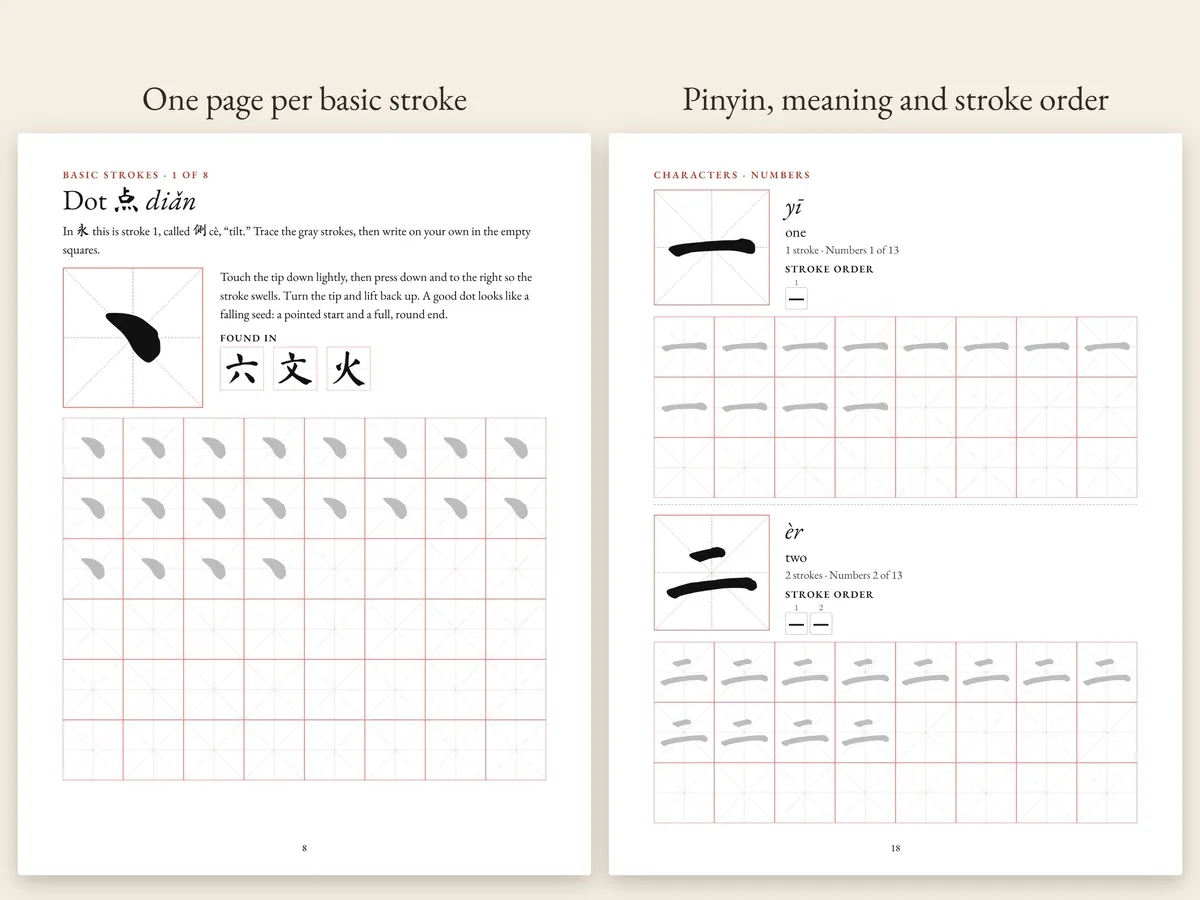
The 8 strokes of 永
The character 永 (yǒng, "forever") contains the eight basic strokes of Chinese calligraphy. Practicing it is a classic first lesson:
- Dot (点 diǎn): a short, heavy touch of the brush.
- Horizontal (横 héng): left to right, rising very slightly.
- Vertical (竖 shù): top to bottom, straight and strong.
- Hook (钩 gōu): a quick flick at the end of a stroke.
- Rising stroke (提 tí): a short stroke up to the right.
- Left-falling (撇 piě): a long sweep down to the left, thinning at the end.
- Short left-falling: a shorter, steeper sweep to the left.
- Right-falling (捺 nà): a stroke down to the right that widens, then tapers.
Stroke order rules
Stroke order makes characters balanced and quicker to write. The main rules:
- Top before bottom: 三.
- Left before right: 川.
- Horizontal before vertical: 十.
- Left-falling before right-falling: 人, 八.
- Outside before inside: 月.
- Close the frame last: 日, 国 (the inside, then the bottom line).
- Middle before the sides: 小, 水.
Rice grid and field grid
Practice squares help you place each stroke:
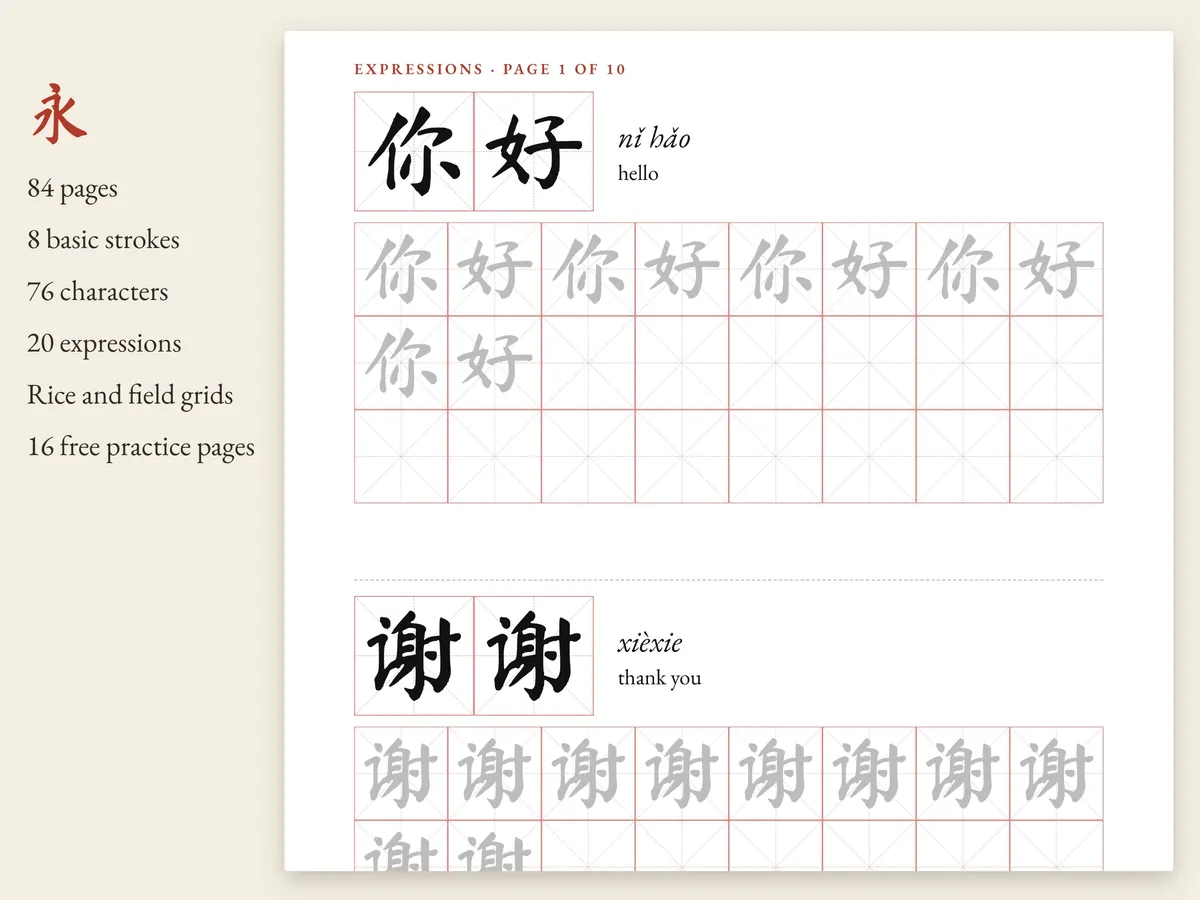
- Field grid (田字格): a square split into four by a cross.
- Rice grid (米字格): the same with two diagonals added, like the character 米.
The lines show the center of the character and where each stroke should start and end. Start with large squares and move to smaller ones as your control improves.
A practice routine
- Warm up with a row of horizontals and verticals.
- Practice one stroke a day for the first week.
- Then write simple characters: 一 二 三 人 大 小 山 水 日 月.
- Trace a gray model three times, then write it three times on your own.
A Chinese calligraphy workbook to follow
Our Chinese Brush Calligraphy Workbook covers supplies, holding the brush and the grids, the 8 strokes of 永 one page each, the stroke order rules, then 76 characters with pinyin, meaning, stroke count and numbered stroke order, 20 expressions such as 你好 and 熟能生巧, and 16 rice grid and field grid practice pages. It works with a brush pen on printer paper. Browse more scripts in the calligraphy and lettering collection.